
The Design of Video-Supported Teaching
Hybrid teaching, that means teaching that takes place simultaneously on site and online, has become an integral part of courses and continuing education at universities. A videoconferencing tool creates a virtual classroom in which lecturers and students meet without being physically in the same place. This opens up many different possibilities for designing teaching. At the same time, there is still limited experience with online teaching, and the tools used were not specifically designed for educational purposes. This raises the question of what particular challenges these new teaching formats bring.
Goal
The goal of the project was to develop guidelines on how effective teaching can be conducted using a videoconferencing tool. In addition, lecturers should be able to develop their digital skills through best-practice examples. In developing the guidelines, we relied on the fundamental dimensions of effective teaching. Furthermore, we examined the possibilities and use of existing videoconferencing tools in higher education from several perspectives.
Results
Videoconferencing tools were originally developed not for teaching, but for (business) meetings.
All videoconferencing tools that we evaluated from multiple perspectives – technical and computer science perspectives as well as UX and educational research perspectives – show clear weaknesses when it comes to designing effective teaching.
In addition to the multi-perspective evaluation, we interviewed students and lecturers in focus groups and consulted experts in higher education didactics to broadly collect opportunities and challenges, ideas, and dos and don’ts for the use of videoconferencing tools.
Based on the multi-perspective evaluation and the results of the focus group interviews, we developed a guideline with recommendations for hybrid teaching at universities.
Further Development
Building on the results of the multi-perspective evaluation and the focus groups, we developed ideas for how videoconferencing tools could be designed to better meet the requirements and goals of university teaching. To support this, we created a matrix for the design of video-supported teaching that combines the UX dimensions of the ISO standard (ISO 9241-110) with the dimensions of effective teaching.
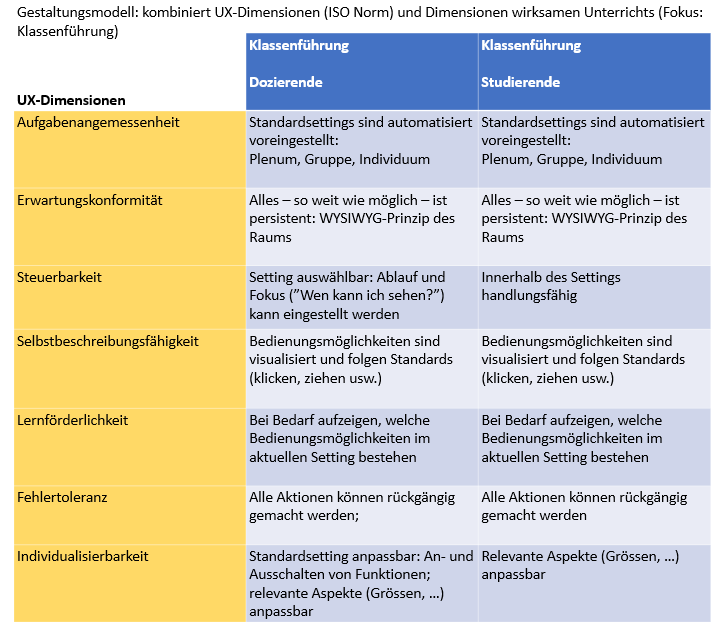
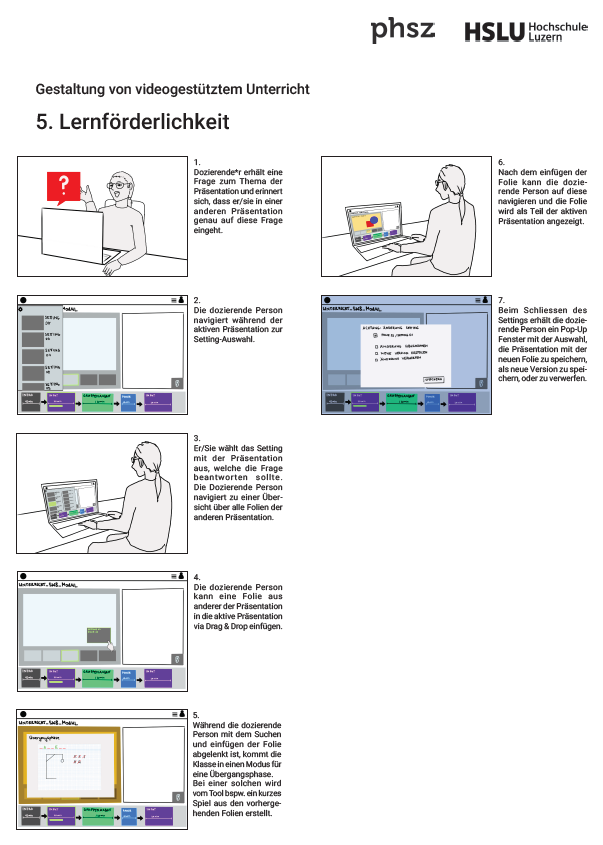
Based on the seven UX dimensions of the ISO standard mentioned above, we also developed ideas for how a videoconferencing tool specifically designed for teaching could look. These ideas were illustrated using storyboards to make them easier to imagine.
We were able to present the results of the guideline, the matrix, and the storyboards at the “Hochschule Digital” conference at PH Lucerne at the end of August 2024.

Project Data
| Project Type | Research |
| Zeitraum | 01.06.2021 – 31.12.2024 |
| Projektpartner | Pädagogische Hochschule Schwyz PHSZ |
| Finanzierung | Projektantrag P8 («Digitale Lehre – Digitale Präsenz – Digitales Studium») |
| Projektteam | Marcel Uhr, Rosina Brosi, Eckart Zitzler |